
The Anomaly Engine
“Anomaly” is my term for odd, interesting issues that show up in apps from time to time. The kind that might turn into a real bug, might be a one-off service hiccup, or might never be seen again. This time, I knew it was a real bug, but I liked its effect and started prompting Fable with:
“I’ve run into a weird issue twice, where in Lost in Space the music cuts out mid section… The thing is, its brilliant if we tweak it a bit, we need the sound to ramp down and ramp back up…”
With only a couple of days left of Fable 5 access, I wanted to see what it could do over a couple of nights while I slept. Anomaly Engine is the result! I captured that sequence, made it tunable, and added it to the Vibes with a rare probability.
What Was the Bug?
Drum-lead handoffs are a rare, deliberate device in the Pulsar solo-handoff system (liborpheus_dsp/src/pulsar_handoff.h): about one in eight handoffs (a 12% roll) pass the lead to the drum track, gated to SoloModeId::LICK_BUILDER mode, and never twice in a row. One of three possible handoff styles is BREAK, which intentionally ducks every other melodic voice so the drum lead can solo alone. That ducking is a real, working arrangement feature, not the bug.
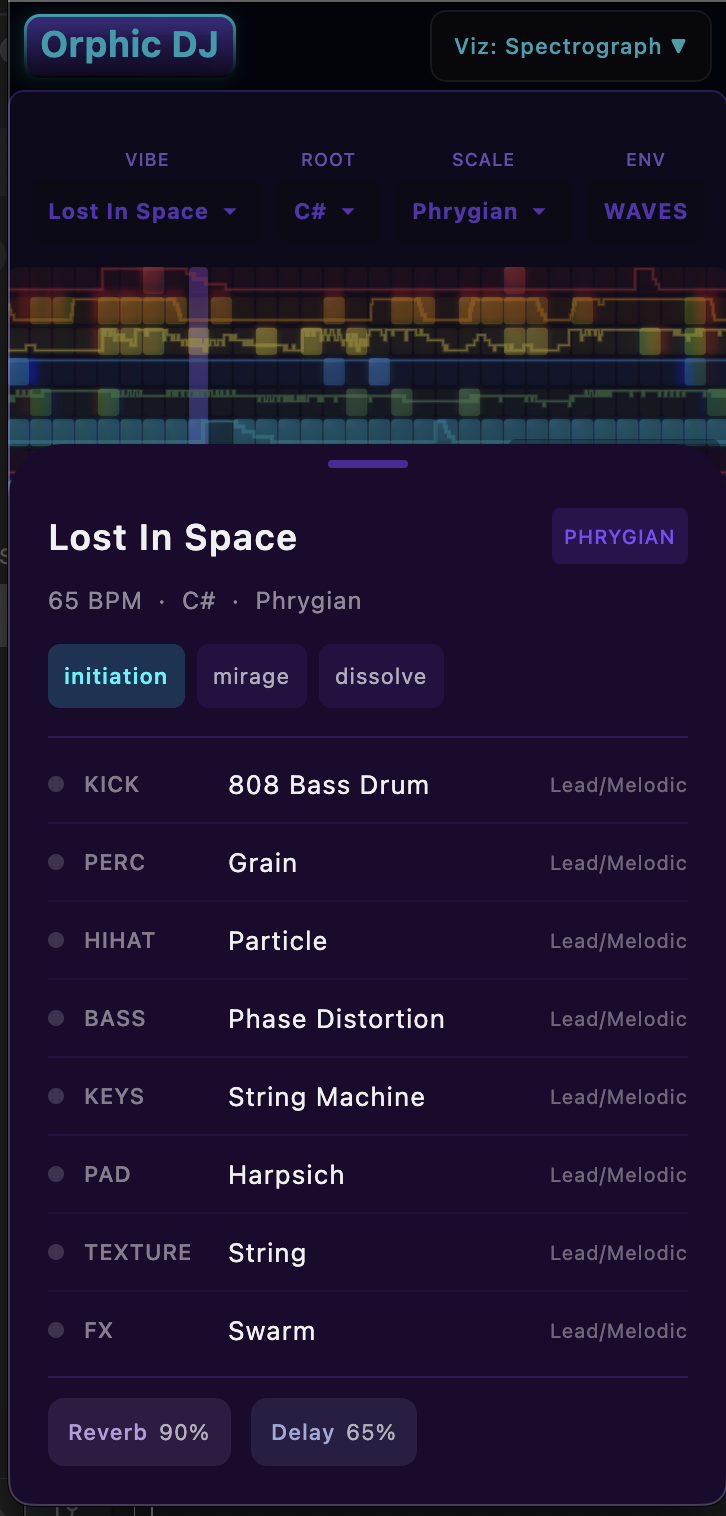
The bug was that nothing exempted the drum lead’s own tracks from that duck when they were also typed Melodic, which is exactly the situation in LostInSpaceVibe.kt: all 8 tracks were Melodic, and zero Percussive. With no percussion track around to dodge the “wipe every Melodic track” filter, a BREAK landing on Lost In Space wiped the drummer’s own just-rendered rhythm along with everything else, silencing the whole sequencer.
The fix is small and specific: render_drum_lead now exempts the lead member’s own tracks, with a code comment documenting the exact failure mode for whoever reads it next.
The Void Anomaly
I kept the session going and had it build the Void Anomaly: a tunable duck where volume ramps down, settles on a near-silent floor (with an optional ghost flicker instead of dead silence), then ramps back up. I wired it into the Vibe system at a rare probability and added a manual trigger. Before I called it a night, I defined the Anomaly schema. That was the deliberate part: get the shape right while the scope is still one effect, so night two is filling in a contract instead of negotiating one.
It landed on main as e3ed37a3, tagged v1.8.0, “Lost in Space, Fire Sky, and Anomalies.”
More Anomalies And Tuning
Night two added seven more: Tape, Scratch, Filter, Crossfade, Cut, Swell, and Wah, plus a per-track lick-wah. The decision I made going in was to build them as reusable Master* output-stage effects rather than one-Vibe specials. Void earned its Vibe-specific hook because it came from a Vibe-specific bug. The other seven had no such excuse, and eight bespoke effects would have been eight places to fix the same problem later.
It landed on main as 78863406, tagged v1.8.1, “Master Anomaly Effects & Pulsar Enhancements.”
By the Numbers
These are the machine-side numbers.
| Metric | Night 1 | Night 2 |
|---|---|---|
| Dates | Fri Jul 17, 8:12 PM to Sat Jul 18, 1:05 PM PDT (about 17 hours) | Sat Jul 18, 9:20 PM to Sun Jul 19, 2:33 AM PDT (about 5 hours 13 minutes) |
| Models | claude-fable-5 + claude-opus-4-8 |
claude-opus-4-8 |
| Subagent dispatches | 44 | 29 |
| Output tokens | 1.73M | 770K |
| Commit | e3ed37a3 (v1.8.0) |
78863406 (v1.8.1) |
One Last Thing
Both v1.8.0 and v1.8.1 used AI to facilitate the release process: tagging, building the AAB and APK, and publishing the GitHub release were all managed by AI after thorough testing (aka listening). I used Antigravity and Gemini-3.5-Flash (high) to push the releases to manage my Anthropic quota.
There’s more on how the Void Anomaly sounds and where it sits in the mix on the orphic-fm devlog. The whole app, DSP engine included, is open source at github.com/balch/orphic-fm-app.